▊ Unsupported applications
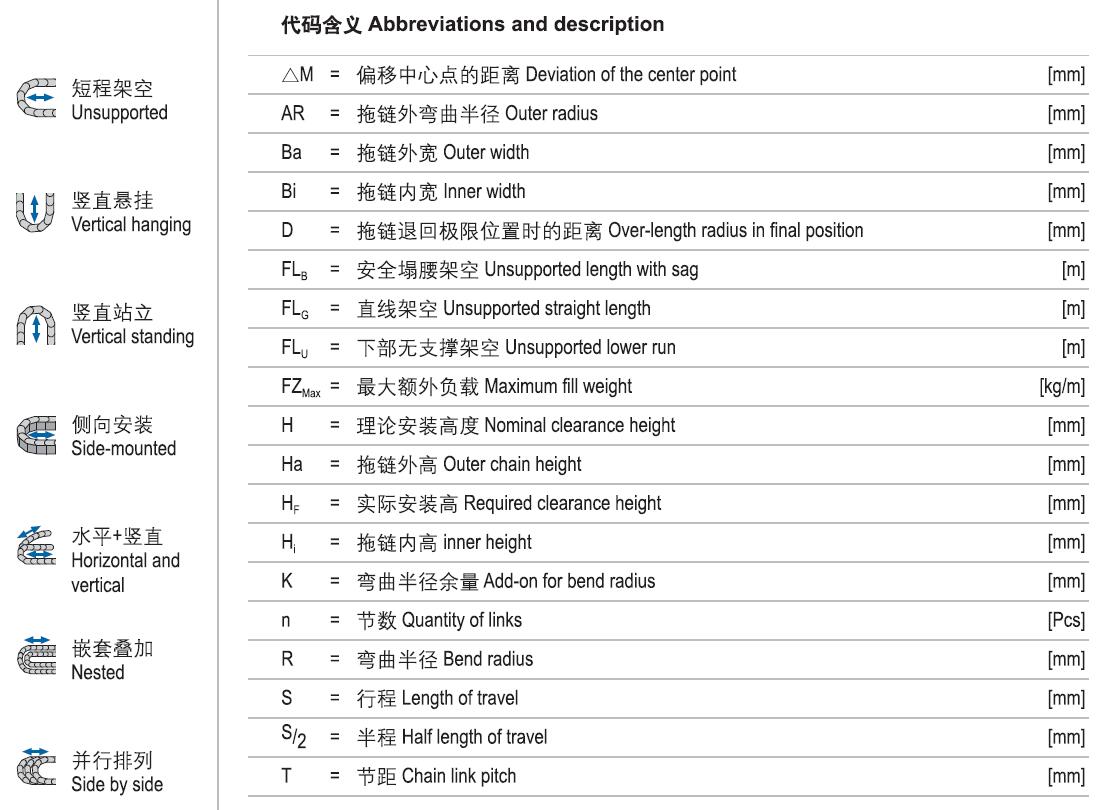
If the upper run of the cable chain operates without touching the lower run over the entire travel, it is called an unsupported application. The distance between moving end and the beginning of the radius curve of the is called the unsupported length. The unsupported application is the most common. DURAMOV® chains are very well suited for high dynamics and long service life. The maximum unsupported length depends on the fi ll weight and the type of the cable chain or tube. As a result, we differentiate among three types of unsupported length.
▊ Unsupported with straight upper run FLG
The cable chain is unsupported FLG when the upper run still has camber, is straight or has a maximum sag of 1/2 of the chain link height. Installing the chain in FLG is always recommended. The runs smoothly without additional vibration.
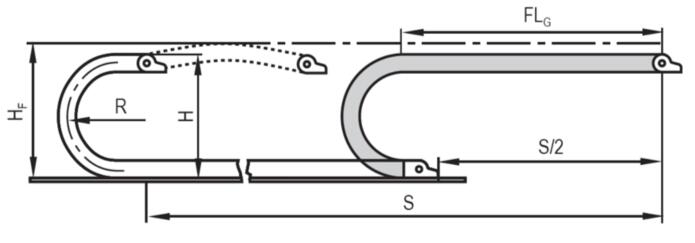
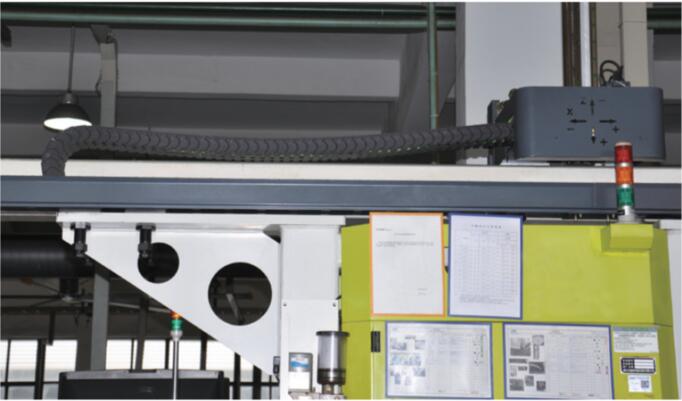
The FLG type of installation always generates the longest service life and can be operated with the max. values for speed and acceleration.
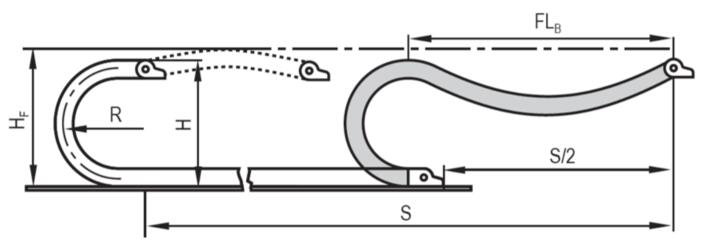
▊ Unsupported with permitted sag FLB
The cable chain is unsupported FLB when the sag is more than 1/2 Chain link height and less than the smallest available radius of this DURAMOV® series. In most applications the can be used unsupported FLB without any problems. There are restrictions concerning the maximum speed and acceleration.
The FLG type of installation always generates the longest service life and can be operated with the max. values for speed and acceleration.
▊ Critical sag
When the sag of the cable chain is higher than allowed for FLB, it is in critical sag. Using an cable chain in critical sag should be avoided or solved with special solutions. An cable chain should never be installed with critical sag. Applications may reach critical sag after long service times. The cable chain or tube should be replaced in these cases.

▊ Vertical, hanging applications
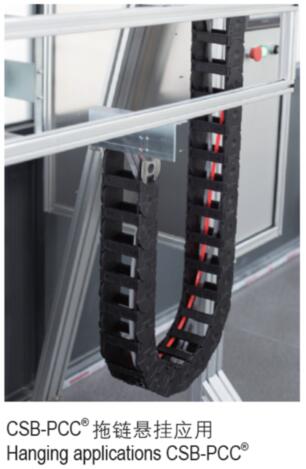
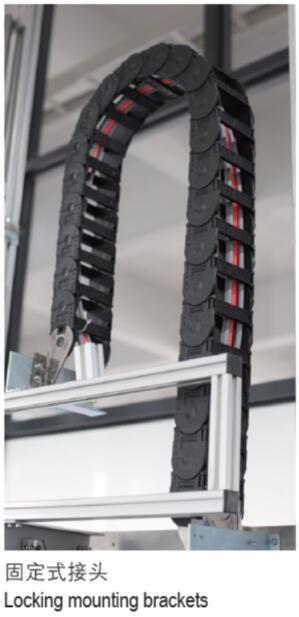
For hanging applications, heights of over 100m are possible with DURAMOV®. Particularly in the area of material fl ow technology, the cable chain enables a bundled supply of a wide variety of cable types. The use of an cable chain ensures that individual cables are not entangled in parts of shelves or protruding pallets. We recommend locking mounting brackets for vertical hanging applications.
▊ Cables and hoses
Two important factors in vertical hanging applications are how the cables and hoses lay in the cable chains and and how they are secured at the end points: all cables and hoses must be hung so that they bear their own weight. The chain the chain fulfi ls the function of orderly conduit bundling only and should not absorb any further tensile forces. The chain interior separation elements should be used for distinct division of all cables and hoses. The cables and hoses must be secured carefully to both end points of the chain. The strain relief must be designed so that the opposite run cannot catch. Safe strain relief and clear separation of the cables and hoses are the basic prerequisites for hanging installations. Cables must be able to move freely and bear their own weight.
▊ Vertical motion with lateral acceleration
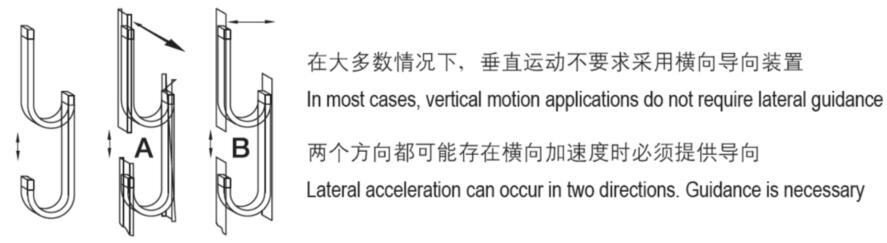
If the application has a purely vertical movement without lateral acceleration, a lateral support is not necessary. If lateral acceleration occurs, lateral guidance of the chain must be provided in most cases. The diagram shows the principle of such guidance. Partial guidance is also an option however, it must at least cover the area in which the chain may sway. Lateral acceleration can occur in two directions. The lateral guidance must be installed accordingly. If you have a choice, the layout in fi gure A is preferred. The lateral acceleration then acts transversely to the chain, where it is more stable. When using a guide, an chain with camber should be selected. This ensures that the chain is pressed into the trough.
▊ Vertical standing applications
Standing applications are standard on many machines and plants. Cables will be guided safely in vertical strokes.
▊ Mounting brackets
The mounting brackets must be attached so that the cable chain cannot bow outwards. Locking mounting brackets are highly recommended because they can be attached fl ush to the machine.
▊ Cables and hoses
Cables and hoses must be laid in the chain so that they can bend freely and bear their own weight. For precise guidance of the cables and hoses, we strongly recommend interior separation elements. Cables must be strain relieved at both ends.
▊ Lateral acceleration
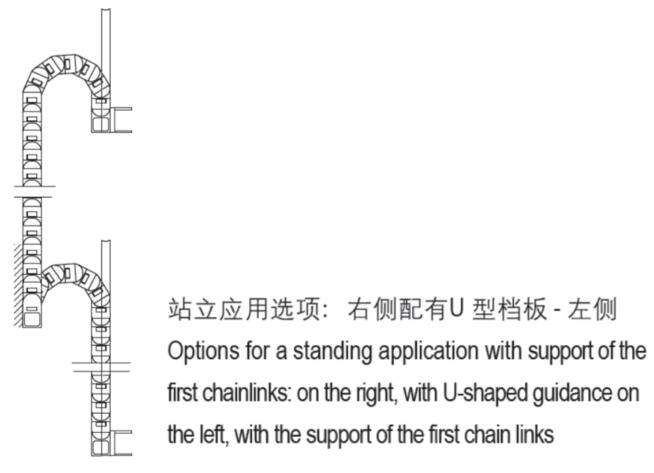
If lateral acceleration occurs, the cable chain should, in most cases, be supported along the outer radius. For higher chain heights, it is generally recommended that at least the first three links on the outer radius be supported. For maximum heights and weights, the whole distance must often be supported. Due to the wide variety of combinations involving fi ll weights, stroke heights, chain types and bend radius, we recommend you contact with us.
▊ Side-mounted Chains
DURAMOV® cable chains placed on their side can be used unsupported to a limited extent. The turned unsupported length in this case is dependent on the following factors:
1、Fill weight
2、Width of the chain
3、Bend radius
4、Parallel placement
We recommend locking mounting brackets for sidemounted applications
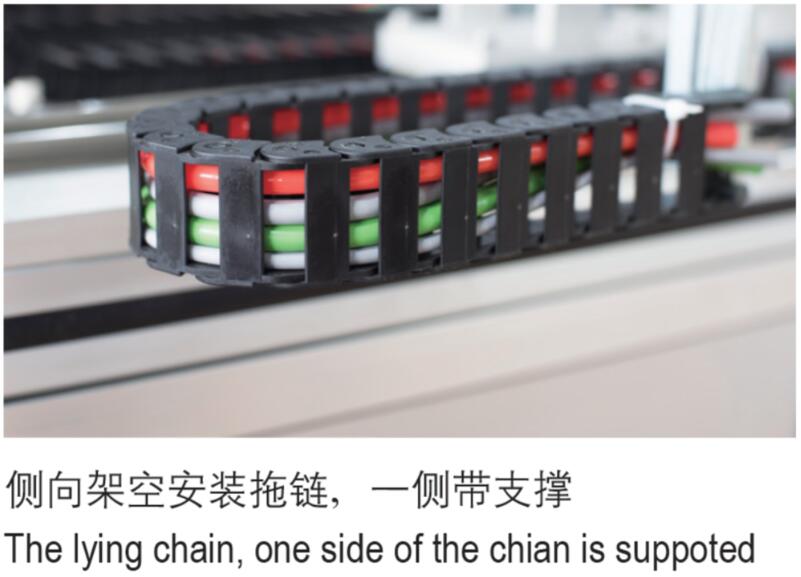
The greater the fi ll weight of the chain, the shorter the available unsupported length. When placed on its side, the chain width, in effect, becomes the height. As this height increases, the cable chain becomes proportionally more stable. If further movement in a second axis is added to the parallel motion of two chains, the unsupported length is impaired. For applications with low fi ll weight, the standard mounting chain is supported brackets are adequate. If, however, the fi ll weight is high and the travels are long, the chain must then be supported either in whole or in part. Due to the variety of application possibilities, we strongly recommend you make use of our consulting services.
Side-mounted chains are strongly recommended if the installation height is restricted.
Standard values for unsupported lengths, side-mounted, upon request. The unsupported lengths can be extended by supporting the links next to the mounting brackets.
▊ Distribution rules | Cables and hoses
In order to ensure that the cable chain is functioning properly and to avoid damage to the cables or hoses, the following principles must be observed when laying cables or hoses:
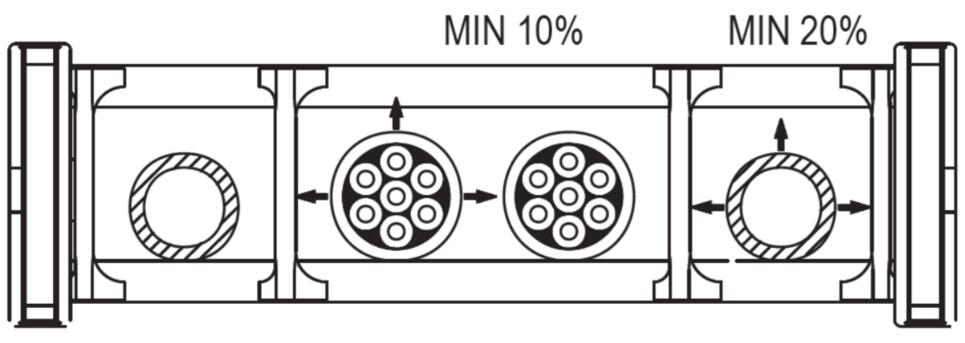 | ▊ This minimum clearance would be 10% for electrical round cables, 20% for hydraulic hoses. |
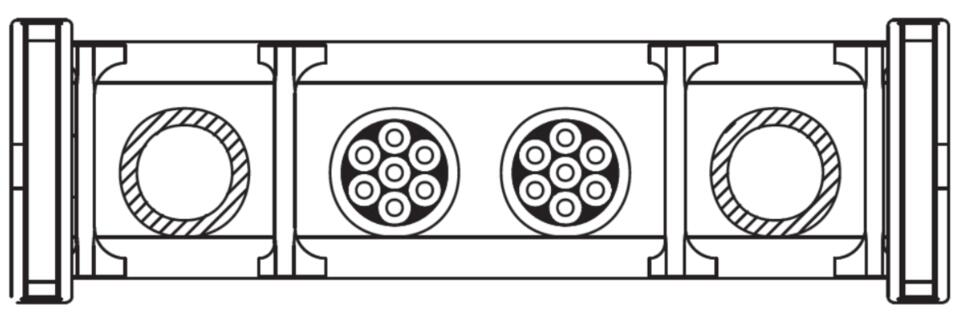 | ▊ In order to reduce the possible friction, avoid pipes with different skin materials such as cables or hoses.(eg: cable and hydraulic hoses) |
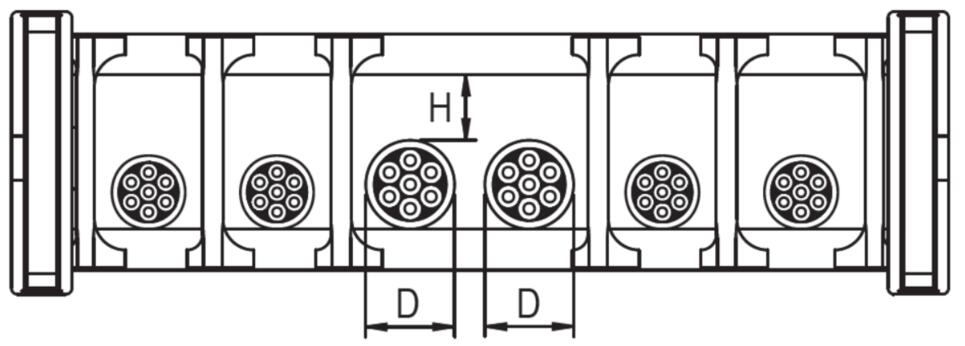 | ▊ In applications where multiple cables and hoses are used, in order to avoid mutual friction between them, it is preferable to place them in a suitable separate space and separate them from each other with a spacer. If there are no conditions to achieve, make sure there is enough space between them to avoid mutual friction (H<D). |
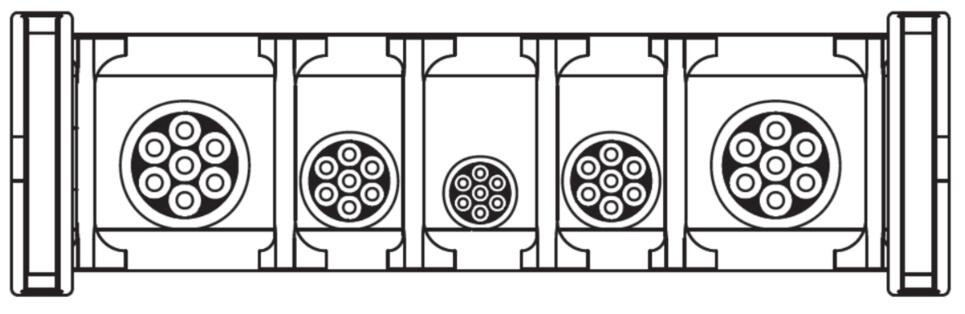 | ▊ The cables or hoses are laid in a symmetrical manner according to their diameter and weight. The largest and heaviest cables are placed on the outside of the section and the small and light cables are placed on the inside. |