▊ PV value
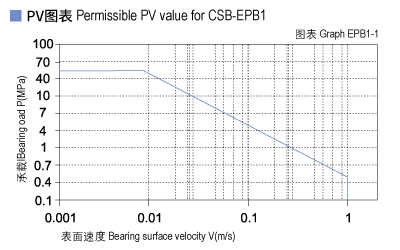
The max PV value of the CSB-EPB1 plastic bearings is 0.50N/mm2×m/s which determines the load capacity of bearing is inversely proportional to the speed. Please refer to the chart for more detailed information (Graph EPB1-1).
▊ Load, speed and temperature
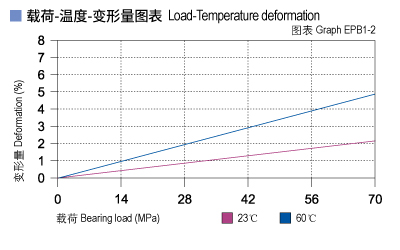
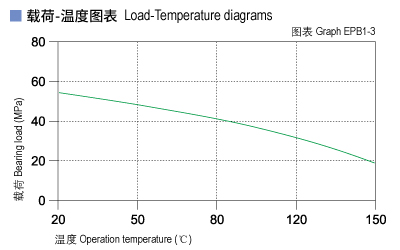
CSB-EPB1 allows the Max static load of 55Mpa, The max compressive deformation rate under the max load is listed in Graph EPB1-2, The actual load capacity of bearing is slightly less than 55Mpa, The bearing load is variable against the speed and temperature, Fast speed (Vmax: 1.0m/s) results into higher temperature (Tmax: 110℃) which decreases the load capacity of the bearing. Please refer to the Graph EPB1-3 for such variation.
▊ Friction factor, wear and shaft material
▉ Friction factor
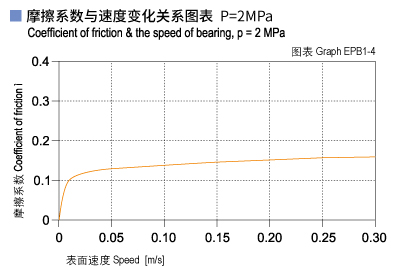
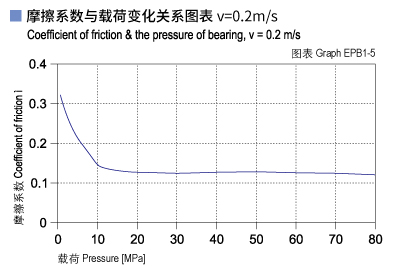
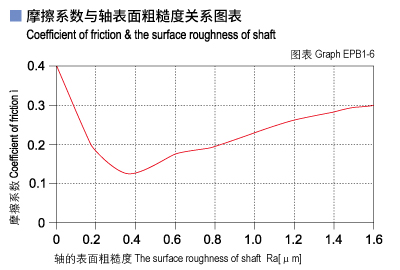
Graph EPB1-4 shows that as the same as most of the slide bearing materials, the friction factor of CSB-EPB1 is increasing along with the rotation speed under a certain loading while as shown in figure EPB1-5, it is decreased along with the increasing of loading when the operation speed is stable. From figure EPB1-6, it is found that the most suitable shaft roughness is Ra0.2 to Ra0.6. Smoother shaft or rougher shaft may result into friction factor increasing.
CSB-EPB1
| Dry
| Grease
| Oil
| Water
|
Friction coef. μ
| 0.08~0.20
| 0.09
| 0.04
| 0.04 |
▊ Wearing and shaft material
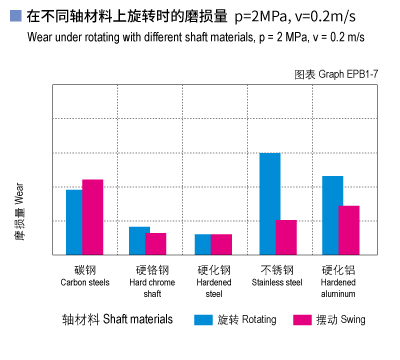
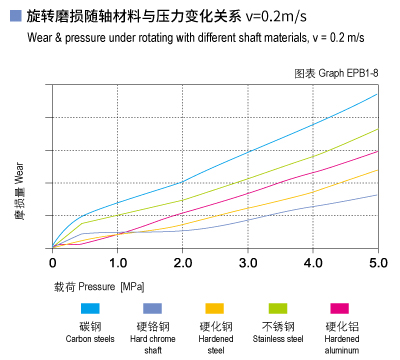
Graph EPB1-8 shows the wearing is considerably affected by the shaft materials. Heat-treated steel shaft and carbon steel shaft is good for this bearing material. CSB-EPB1 is suitable for hardened chrome steel and hardened steel shaft in oscillation operation and is suitable for hardened chrome steel and hardened steel shaft in rotation operation.
▊ Chemical resistance
CSB-EPB1 is good at chemical resistance against weak acidic medium and various kinds of lubricants.
▊ Water absorption
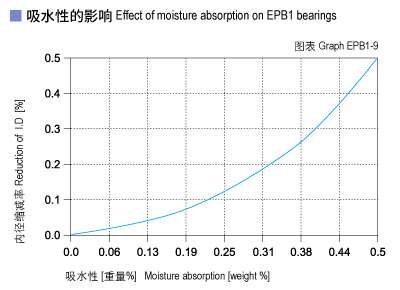
The moisture absorption of CSB-EPB1 plastic plain bearings is 0.2% in standard atmosphere. The max. water absorption is 0.5% in water . These values are very low, CSB-EPB1 plastic palin bearings is very well suited for used in wet applications.
▊ UV resistance
Disintegration could be possible for the material CSB-EPB1 after long period of exposing under the UV ray and therefore the performance of the material will be reduced.